How to Make Your Website Visible in AI Search (No Technical Skills Needed)
A few years ago, getting your business found online meant one thing: ranking on Google.
But today people are no longer just typing keywords into search engines and clicking links. More users are turning to AI tools like ChatGPT, Gemini and Perplexity to get instant answers instead.
Which means your website now has a new job:
not just ranking but being understood.
The good news is you don’t need technical expertise in search engine optimization using AI to improve visibility.
You just need the right structure, content strategy and user-focused approach. Let’s break it down.
Why AI Search Is Changing the Rules of SEO
Traditional SEO focused heavily on rankings and how to optimize search engine ranking for page one visibility.
This is where the relationship between AI and SEO is changing rapidly.
Instead of showing users ten blue links, AI systems generate direct answers by pulling information from different websites and summarizing it instantly.
In simple terms:
AI tools are not just searching your website. They are interpreting it.
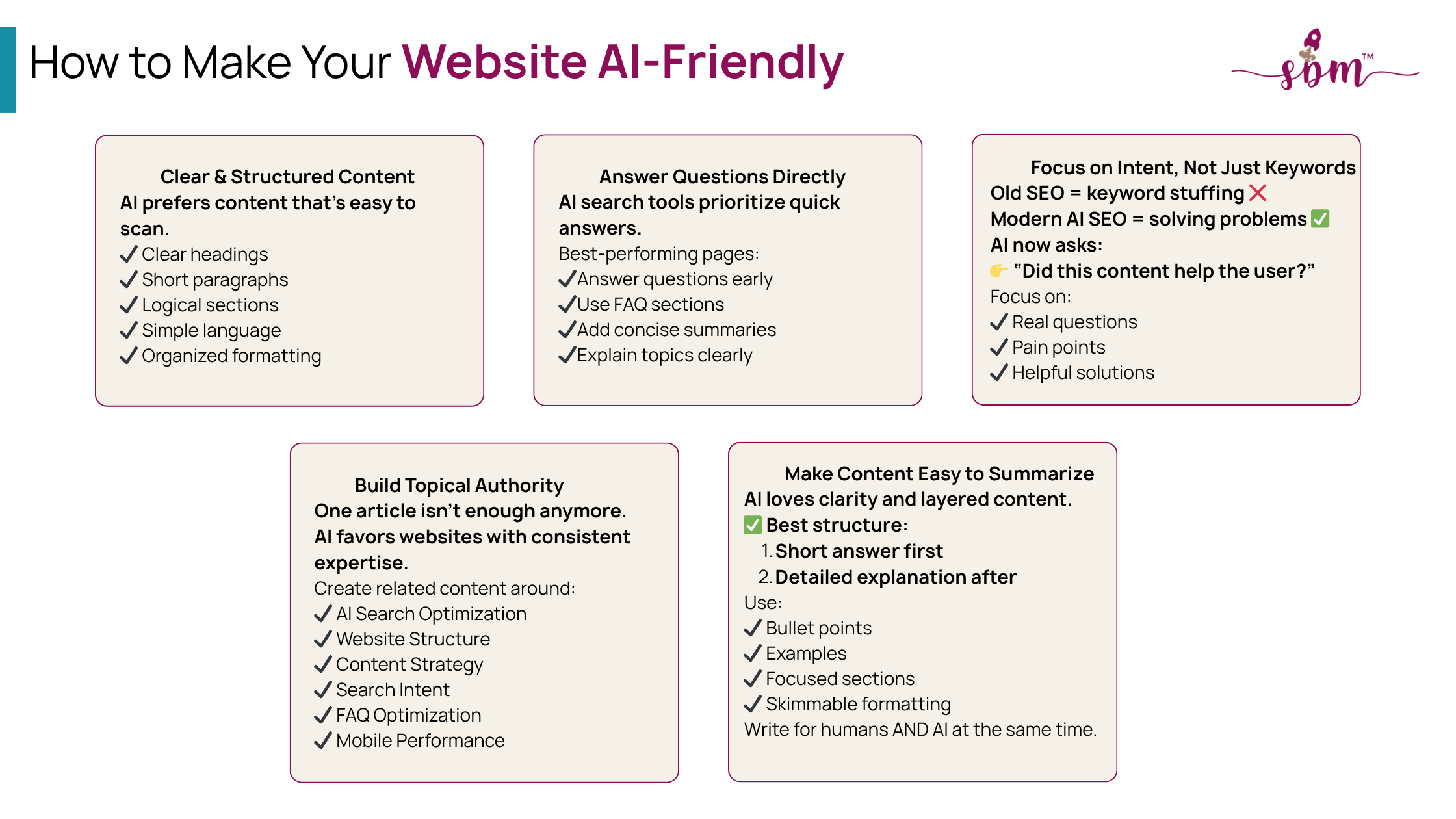
How to Make a Website AI-Friendly?
Many businesses assume AI visibility is highly technical.
In reality, most of it comes down to creating content that is easy to understand, well-structured and genuinely useful.
Here’s what matters most.
1. Clear and Structured Content
AI tools prefer content that’s easy to scan and organize.
Content becomes easier for AI systems to process when it includes:
Clear headings
Logical sections
Short paragraphs
Organized formatting
Simple language
2. Answer Questions Directly
AI search tools are designed to answer questions quickly.
This is also a key principle in understanding how to rank in google ai overview results, where clarity and directness matter more than long-form complexity.
Pages that perform well in AI search:
Answer questions early
Use FAQ sections
Include concise summaries
Explain topics clearly
This is why blogs, guides and educational content are becoming even more important in 2026.
The easier your content is to extract answers from, the higher your chances of appearing in AI-generated responses.
3. Focus on Search Intent, Not Just Keywords
Keywords still matter. But intent matters more.
Older SEO strategies focused on repeating the same phrase endlessly across a page. AI systems are smarter than that now.
Instead of asking: “How many times did this keyword appear?”
AI tools evaluate: “Did this content actually solve the user’s problem?”
That’s why businesses should focus on creating content around real questions, pain points and solutions rather than keyword stuffing.
4. Build Content Depth and Authority
One blog post isn’t enough to establish credibility anymore.
AI systems favor websites that demonstrate consistent expertise around a topic.
This is called topical authority.
For example, instead of publishing one general SEO article, a business should create related content around:
AI search optimization
Website structure
Mobile performance
Content strategy
Search intent
FAQ optimization
5. Make Your Website Easy to Summarize
AI search tools love clarity.
One of the simplest ways to improve visibility is to structure your content in layers:
Short answer first
Deeper explanation afterward
This format helps AI systems quickly identify key takeaways while still giving users valuable context.
For example:
Start sections with a direct explanation
Follow with examples or details
Use bullet points where appropriate
Keep ideas focused and organized
Write content that’s skimmable for humans and digestible for AI at the same time.
Technical SEO Still Matters
Even though AI search is evolving rapidly, the basics still matter.
Your website still needs to:
Load quickly
Work properly on mobile devices
Be easy to navigate
Have clean page structures
Be indexed correctly
Common Mistakes Small Businesses Still Make
Writing only for keywords
Overstuffing pages with repetitive phrases
Publishing generic content with no depth
Ignoring formatting and readability
Neglecting mobile optimization
Failing to update old content
Learn how to fix these here: How AI Overviews Are Changing Google Search in 2026
Popular Questions
What's the Difference Between AI Overview Rankings and Regular Google Rankings?
Traditional Google rankings focus on listing webpages, while AI Overviews summarize and combine information from multiple trusted sources into one direct answer.How to Write Content That AI Search Engines Can Use?
Create content with clear headings, direct answers, logical structure and useful context.Can Small Businesses Rank in Google AI Overview?
Yes. Google AI Overview prioritizes relevance and helpful answers over brand size, which gives small businesses with niche expertise and well-structured content a strong opportunity to compete.Does Schema Markup Help You Rank in AI Overview?
While it’s not a guaranteed ranking factor, it improves clarity and discoverability for AI search tools.Is Mobile Optimization Important for AI Overview Rankings?
Absolutely. AI search systems still rely on mobile usability and user experience signals to evaluate website quality and trustworthiness.