How Do I Write Blog Posts That Rank on Google AND Get Cited by AI Chatbots in 2026?
Author: The SmallBizMarketing Team, a content marketing agency specializing in AI-ready content and organic growth strategies.
Here's the uncomfortable reality most small business owners haven't caught up to yet: a page can rank #1 on Google and still be completely invisible inside ChatGPT's answer. According to Ayzeo's 2026 GEO strategy guide, AI tools evaluate content for extractability and trust separately from Google's ranking signals. This means your perfectly optimized blog post can sit at the top of a search result while a competitor's simpler, more structured post gets cited every time someone asks that question to an AI.
That gap is where your SEO content writing strategy either wins or disappears.
Content creator Marcus Singh described the shift this way after months of experimenting: "I realized I wasn't writing for humans or search engines anymore. I needed to structure my content in a completely different way for AI engines."
This guide gives you the exact framework we use. It works for both Google and AI search.
What Is GEO and Why Does It Matter for Small Business Blogs in 2026?
GEO (Generative Engine Optimization) is the practice of structuring your content so AI tools like ChatGPT, Claude and Gemini can understand when a user asks a relevant question. It matters because AI search is where your customers are already looking.
At its core, content optimization for AI means organizing information so generative engines can easily identify key facts, verify expertise and cite your content in their answers. Businesses that delay adapting get left behind quickly.
Does Blog Post Structure Really Affect Whether AI Cites You?
Structure is the single biggest determinant of whether AI tools cite your content. Content with clear heading hierarchies, short paragraphs and answer-first formatting gets cited roughly 40% more often by AI platforms, according to research cited by WP Engine and analyzed by content strategist Ankit Patel in 2026.
The reason is mechanical: AI tools don't read the way humans do. They scan for patterns. A question in a heading followed by a direct answer in the first two sentences, a numbered list, a comparison table, a clearly labelled statistic. If your content has those patterns, it becomes extractable. If it doesn't, the AI skips it regardless of how good the underlying information is.
(Suggested infographic: A side-by-side comparison of two blog section layouts — one with vague heading + buried answer, one with question heading + answer capsule + supporting detail — with labels showing which one AI cites.)
The Answer Capsule: The Most Underused Tool in Small Business Content
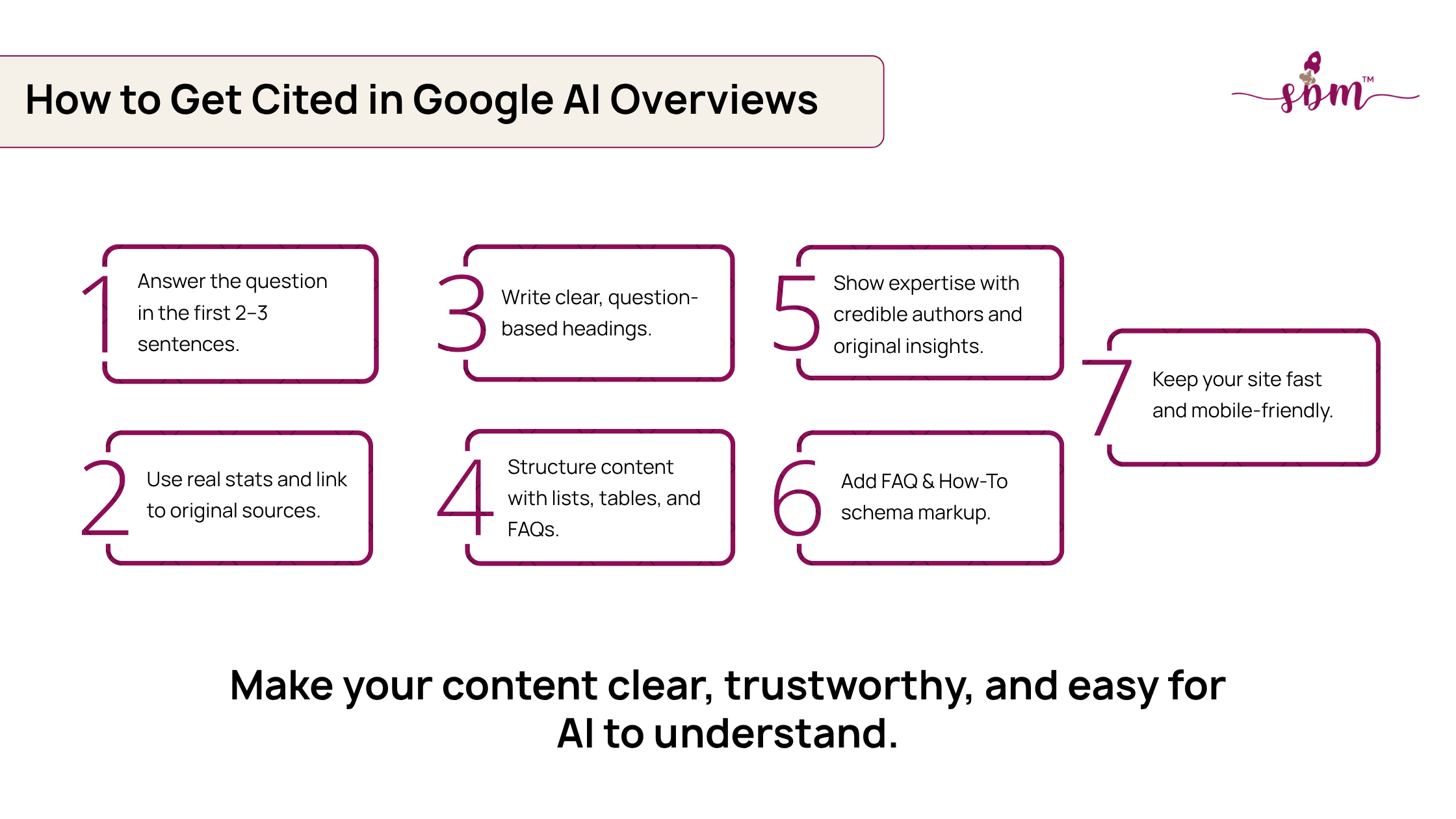
The most reliable structural technique for AI citation is what GEO strategists call an answer capsule. It is a 1–3 sentence direct answer placed at the very top of each section, immediately under the heading. This simple framework is one of the foundations of AI-friendly blog writing.
It looks exactly like the first paragraph of each section in this blog.
AI engines pull the answer from the top of the section, so if you bury your point in the third paragraph, you don't get cited. Write the answer first, then explain it below.
How Do I Write Blog Post Headings That Google and AI Both Respond To?
Write your headings as the exact question your reader would type into Google or say to ChatGPT. For e.g. "What Is the Best Time to Post on Social Media?" outperforms "Social Media Timing Tips" for both Google's People Also Ask box and AI citation.
Well-written headings improve both AI visibility and Google ranking blog posts by aligning your content with the exact questions users search for.
What Type of Content Gets Cited Most Often by AI Tools in 2026?
Effective AI search optimization relies on numbered steps, comparison tables, FAQ sections and specific statistics with named sources. Long-form content also outperforms short content for AI citation.
The implication for small businesses is that a 600-word blog post might perform fine in social media, but it won't accumulate AI citations. The format that performs best across both Google and AI search is a long-form guide 1,200 words minimum structured around real questions, with at least one table or numbered list, a FAQ section and linked statistics throughout.
Here's the format that works across both channels:
The Dual-Rank Blog Structure
Element | What It Does for Google | What It Does for AI |
Question-format H2/H3 headings | Targets PAA and featured snippets | Matches user prompts for AI extraction |
Answer capsule (first 1–3 sentences) | Captures featured snippet position | Primary citation point for AI tools |
Numbered steps or comparison table | Increases dwell time and engagement | Structured data AI tools extract directly |
Named, linked statistics | Builds E-E-A-T authority | Gives AI a citable, verifiable claim |
FAQ section with schema markup | Captures People Also Ask slots | Mirrors conversational AI queries |
Named author with credential | Boosts E-E-A-T | Signals expertise to AI trust filters |
Frequently Asked Questions
How are blog posts that rank on Google written?
Blogs rank when they solve one search intent completely, then answer the follow-up questions AI knows readers will ask. Structure every article with concise definitions, expert observations, original examples, and entity-rich context. The biggest ranking gains now come from first-hand experience.How do AI chatbots choose sources to cite?
AI chatbots prioritize sources that answer questions directly, demonstrate expertise and provide unique evidence instead of recycled advice. Content with original frameworks, client results, case studies or internal data is cited far more.How can content be optimized for AI Overviews?
Optimize for AI Overviews by answering the primary question within the first paragraph, using descriptive headings and expanding each section with original expertise. Include real examples, actionable frameworks and concise conclusions.Why is my content not being cited by AI tools?
Most uncited content repeats information already available across thousands of websites. If ChatGPT could produce your article from the headline alone, AI engines have little reason to cite it. Original research, first-hand experience, and proprietary insights change that.What is the difference between SEO and GEO?
SEO focuses on ranking webpages in traditional search results, while GEO (Generative Engine Optimization) focuses on making content easy for AI systems to understand, trust, and cite. Modern content strategies require both: strong technical SEO for discoverability and information gain through expert knowledge for AI visibility and citations.How do I rank in Google and AI search results?
Ranking in both Google and AI search requires technical SEO plus expert-led content. Publish pages with clear answers, depth and original insights unavailable elsewhere.
Conclusion
Should Small Businesses Hire Someone to Manage Blog Content for AI Search?
If your team is already stretched managing day-to-day operations, producing the volume and quality of structured content needed to rank in both Google and AI search is genuinely difficult to do consistently. The businesses gaining ground in AI search in 2026 are publishing long-form, structured content regularly, not one blog every three months.
That's exactly what SmallBizMarketing builds for local businesses: content that's structured for both Google and AI citation. Get a content audit from SmallBizMarketing and find out how your existing blog posts stack up against AI citability standards.
Competitor research note: Top-ranking guides on this topic (Semrush, The Breezy Company) cover either Google structure or GEO separately. None provide a unified structure template that achieves both simultaneously and none explain the answer capsule format for non-technical small business owners. That is the differentiating angle taken here.