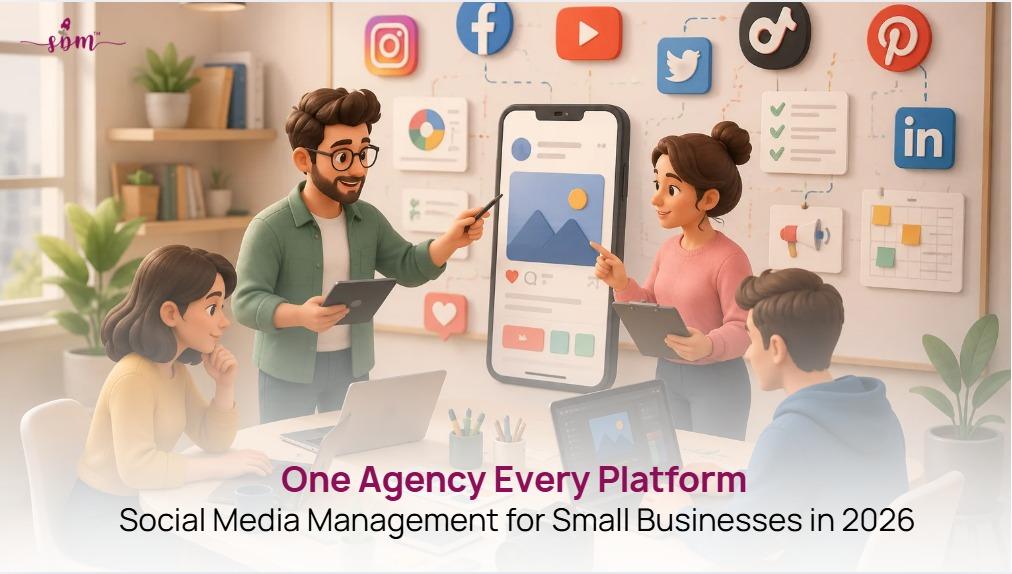
One Agency, Every Platform: Why Small Businesses Are Consolidating Social Media Management in 2026
Author: The SmallBizMarketing Team, small business marketing specialists in multi-platform content strategy.
Are you managing multiple social media platforms while running your business? It might be costing you more than you think.
According to Constant Contact's 2026 survey, 68% of small business owners believe social media will deliver more value than any other marketing channel this year. Yet many still manage every platform separately or split the work across different vendors, missing opportunities.
The businesses seeing the best results are managing everything from one place with one clear strategy.
Here's why more small businesses are consolidating their social media management and how you implement it.
What Is Outsourced Social Media Management?
Outsourced social media management means hiring an agency to handle your:
Content creation
Scheduling
Community management
Reporting
Strategy
Instead of hiring an in-house employee or asking existing staff to fit social media in, you gain access to a full marketing team.
For many small businesses, outsourcing is also more cost-effective.
An in-house social media employee can cost $50,000 to $70,000 annually once salary, benefits, software, and training are included.
A full-service digital marketing agency typically costs $2,500 to $6,000 per month, while providing strategy, design, content creation, analytics, and campaign management instead of relying on one person.
Why Are Small Businesses Consolidating Social Media Under One Agency in 2026?
Instead of coordinating multiple freelancers or departments, one agency manages every platform using the same strategy and brand guidelines.
This has become even more important as AI becomes part of social media marketing.
The biggest benefits are:
Consistent brand voice
Faster campaign execution
One team accountable for results
AI performs best when it learns from one consistent brand voice. When Instagram, Facebook, and LinkedIn are managed by different people, AI receives mixed signals, making content recommendations and optimization less effective.
The Risks of Fragmented Social Media Management
Managing different platforms separately creates hidden costs that rarely appear on a budget sheet.
Inconsistent Brand Voice
Customers check multiple platforms before choosing a business.
If your Instagram feels friendly, LinkedIn sounds corporate, and Facebook hasn't been updated in weeks, your brand appears inconsistent.
That inconsistency reduces trust.
Slower Campaigns
Launching promotions becomes more complicated when several people are responsible for different channels.
Instead of publishing together, campaigns often go live days apart, reducing momentum and engagement.
Duplicate Work
Separate vendors use different tools, reporting systems, and workflows, leading to unnecessary spending and repeated effort.
What Does a Consolidated Social Media Strategy Actually Look Like?
A consolidated social media strategy brings every platform together under one plan. Each platform still receives content tailored to its audience, but every message supports the same business goals.
This approach is a core part of effective social media content management, where planning, creation, publishing, and analysis work together instead of operating separately.
What consolidation looks like on a monthly basis:
Function | Fragmented Model | Consolidated Model |
Content calendar | Built separately per platform or vendor | One unified calendar across all platforms |
Brand voice | Varies by who's writing | Single brand guide applied everywhere |
Campaign timing | Coordinated via back-and-forth emails | Synchronized at the planning stage |
Analytics reporting | Separate reports from each vendor/platform | One integrated performance dashboard |
Accountability | Unclear when results drop | Single agency responsible for all results |
AI workflow | No consistent brand signal to learn from | Unified brand brief powers AI optimization |
How Many Platforms Should a Small Business Be Active On in 2026?
For most businesses, two to three platforms are enough.
Trying to stay active everywhere usually results in inconsistent posting and lower-quality content. Focus on where your customers spend time.
A few common combinations include:
Restaurants: Facebook, Instagram, TikTok
B2B businesses: LinkedIn, Google Business Profile, Facebook
Retail stores: Instagram, Facebook, Pinterest
Growing consistently on a few platforms almost always outperforms spreading your efforts across six or seven.
Final Thoughts
Social media works best for small businesses when it creates a connected experience for customers.
When every platform follows the same strategy, performance becomes much easier to measure.
If you're spending too much time coordinating multiple platforms or vendors, consolidating your social media management could be one of the simplest ways to improve both efficiency and results.
Looking for a smarter way to manage your social media? SmallBizMarketing helps small businesses build one unified strategy across the platforms that matter most.
Book a social media audit at info@smallbizmarketing.agency to discover where your current approach is working, where it's falling short, and how a consolidated strategy can help you grow with confidence.
Frequently Asked Questions
What is outsourced social media management?
Outsourced social media management is hiring an agency to manage your content creation, scheduling, community engagement, analytics, and overall strategy across your social media platforms.Is hiring a social media management agency worth it for small businesses?
Yes. It provides consistent content, professional strategy, detailed reporting, and access to an experienced marketing team without the cost of hiring full-time staff.How much does social media management cost?
Most small businesses spend between $1,500 and $5,000 per month, depending on the number of platforms, posting frequency, and services included.How many social media platforms should a small business manage?
Most businesses achieve better results by focusing on two to three platforms where their target audience is most active instead of trying to maintain every social network.