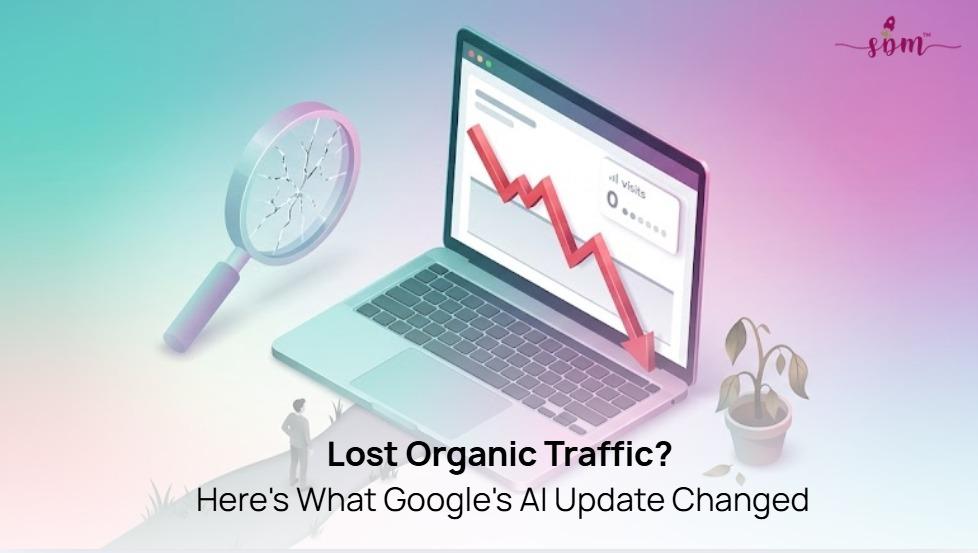
Why Did My Organic Traffic Drop After Google's AI Overview Update in 2026?
Author: The SmallBizMarketing Team, helping businesses recover organic traffic and adapt to Google's AI-powered search.
Your organic traffic dropped after Google's AI Overview update because Google AI Overview summaries now appear at the top of search results for nearly half of all queries, answering the user's question before they ever reach your website.
But here's what most blog posts about this topic won't tell you: the traffic loss and the solution are not the same for every business. And if you're reading your Google Analytics data without knowing what to look for, there's a good chance you're diagnosing the wrong problem entirely.
This guide explains exactly what happened, how to tell whether AI Overviews specifically caused your drop, and most importantly why getting cited inside an AI Overview is now worth more than ranking #1 without one.
What Are Google AI Overviews and Why Do They Reduce Traffic?
Google AI Overviews are AI-generated answer summaries that appear at the top of search results, above all organic listings. They reduce traffic because they resolve the user's query directly on the results page, eliminating the need to click through to any website.
As of early 2026, AI Overviews trigger on approximately 48% of all tracked search queries, according to BrightEdge's 2026 data. The Pew Research Center found that click-through rates drop to around 8% when an AI summary is displayed, compared to 15% without one.
How Do I Know If AI Overviews Caused My Traffic Drop?
You can confirm AI Overviews caused your traffic drop by checking a specific pattern in Google Search Console.
How to run the diagnosis in Google Search Console:
Go to Performance → Search Results
Set a 12-month comparison (this year vs. last year for the same period)
Enable the Impressions, Clicks, CTR, and Average Position columns
Sort by largest drops in clicks
For each affected page, check: are impressions holding or growing? Is the average position stable? Is CTR down significantly?
Use the Search Appearance filter to isolate queries where AI Overviews appeared
If impressions are up and position is flat but CTR has collapsed, AI Overviews are the cause.
Which Types of Content Lose the Most Traffic to AI Overviews in 2026?
Content Type | AI Overview Exposure | Typical CTR Impact | Recovery Strategy |
How-to blog posts | Very high | -42% to -61% | Reformat for AI citation; add unique data |
Definition/explainer pages | Very high | -40% to -58% | Build into topic clusters; add schema |
Comparison guides | High | -30% to -45% | Add original research; target transactional angle |
Service/product pages | Low | -5% to -15% | Minimal change needed |
Local landing pages | Low | Minimal | Prioritize Google Business Profile |
Breaking news content | Low | +103% growth | Invest in news-style publishing |
Is the Traffic Loss Permanent or Can I Get It Back?
Understanding Google AI Overview traffic loss is the first step toward recovery because declining clicks do not always indicate declining rankings. The traffic loss from AI Overviews can be repaired by a different kind of visibility: getting cited in the AI Overview.
Being inside the AI Overview isn't just damage control. It's a competitive advantage.
How Do I Get My Business Cited in Google AI Overviews?
Successful AI SEO focuses on making content easy for Google's language models to understand, verify and confidently cite. They look for:
A direct, specific answer in the first 2–3 sentences of each section
Named statistics with linked original sources (vague claims don't get cited)
Clear heading hierarchies that mirror how users ask questions
Structured content: numbered steps, comparison tables, FAQ sections
E-E-A-T signals: named author with credentials, original data or case studies, external links to primary sources
Schema markup — particularly FAQPage and HowTo schema — which makes content interpretable to AI systems
Fast, mobile-friendly pages that AI crawlers can access and parse quickly
Frequently Asked Questions
What is the reason for organic traffic drop after AI Overviews?
Organic traffic dropped because Google now answers many informational queries directly in AI Overviews, reducing clicks even when your rankings stay the same. The biggest losses occur on generic, top-of-funnel content.What is the effect of AI Overviews on SEO?
AI Overviews shifted SEO from ranking pages to becoming a trusted source AI cites. Keyword optimization alone no longer wins. Pages with original research, expert insights, case studies and entity-rich topical coverage earn more visibility because Google's AI prioritizes information unavailable elsewhere rather than rewritten summaries of existing content.How to recover lost organic traffic?
Replace generic articles with expert-led content that AI can reference. Add first-hand experience, proprietary frameworks, client examples, original statistics and topical clusters around commercial intent.What has changed in Google's AI Overview update?
Google's AI Overview update changed search from listing pages to synthesizing answers from trusted sources. Ranking first no longer guarantees clicks. Google's systems increasingly reward Experience, Expertise, Authority and Trust backed by original insights.How can I use AI for SEO?
Use AI to accelerate research, content briefs, topical clustering, schema generation and content gap analysis, but never for the final expertise. Use AI for efficiency while adding human experience, industry examples, proprietary data and expert editing that AI cannot independently produce.Why has my website lost organic traffic?
Most websites lose organic traffic because search intent, Google's AI results and content quality standards changed simultaneously. Check whether rankings declined or clicks dropped despite stable positions. If rankings remain steady but traffic falls, AI Overviews are absorbing informational searches.
Conclusion
Should I Be Tracking Traffic Differently Because of AI Overviews?
Yes, raw session counts are the wrong primary metric in 2026. The businesses that are accurately measuring performance are tracking:
AI citation rate,
branded search volume growth and
conversion rate by traffic source alongside total sessions.
The diagnostic shift that matters most for small businesses: open Google Search Console and add the AI Overviews filter under Search Appearance. It was added to Search Console in mid-2025 and shows you exactly which queries are triggering AI Overviews for your content. That data tells you where you're being summarized without getting clicked and where restructuring your content for citation could recover the most value.
Contact SmallBizMarketing (info@smallbizmarketing.agency) for a comprehensive SEO audit and discover how our AI SEO services help businesses recover traffic with content that earns rankings, citations, and qualified leads in 2026.
Competitor research note: Top-ranking competitors on this topic (Seer Interactive summaries, Search Engine Land, Semrush blog) explain the CTR drop but frame it as pure loss. None walk through the Google Search Console diagnostic to distinguish AI Overview impact from algorithm ranking drops. The diagnosis step is the differentiation here.